
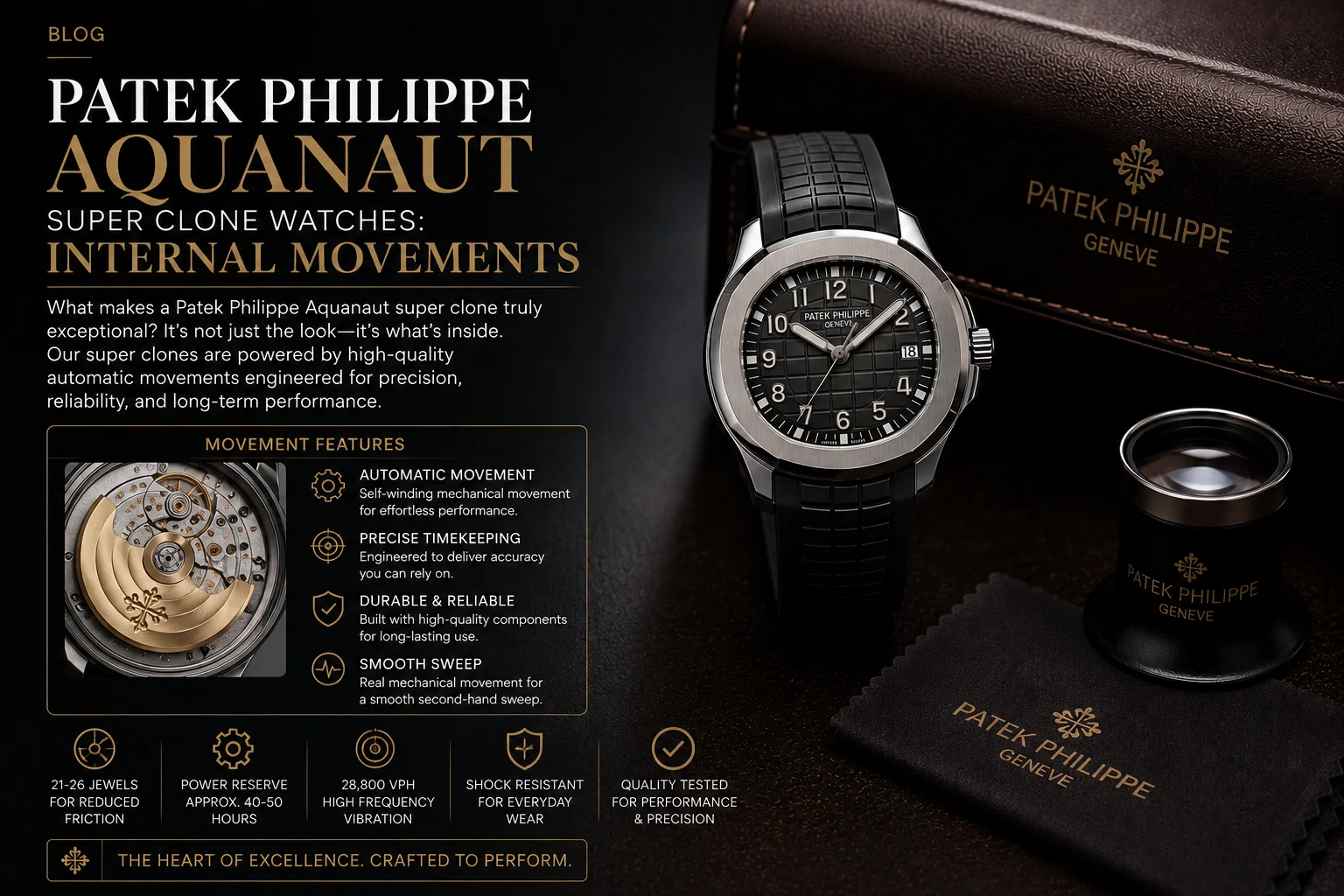
Patek Philippe Aquanaut Super Clone Watches: Internal Movements
How do Patek Philippe Aquanaut super clone watches actually work inside, and what kind of movements and calibers are used in modern replicas?
This article explains clone movements, automatic calibers, Swiss movement replicas, and factory differences such as 3KF and ZF. You will also learn how these movements compare in performance, reliability, and accuracy against genuine luxury watch mechanics.
Let’s break down the technical side of super clone watches so you can understand what is really ticking inside these Aquanaut-style replicas.
Understanding Clone Movements in Aquanaut Super Clones
The movement is the heart of Patek Philippe Aquanaut super clone watches, and modern replicas often use highly modified automatic calibers designed to mimic Swiss luxury engineering.
These clone movements aim to replicate not only timekeeping performance but also the visual layout of genuine Patek Philippe calibers, including rotor design, bridge structure, and finishing patterns.
What Are Automatic Calibers in Super Clones?
Automatic calibers in replica watches are self-winding mechanical movements that use wrist motion to generate energy. In high-end super clones, these calibers are often heavily modified versions of proven base movements.
Many Aquanaut replicas use automatic systems that attempt to mirror the original Patek 324 SC movement architecture, although internal engineering is simplified for mass production.
Swiss Movement Replicas Explained
Swiss movement replicas refer to clone watches that either use Swiss-made base movements or are marketed as “Swiss-grade” due to their finishing and assembly standards.
In reality, most Patek Philippe Aquanaut super clone watches use Asian-made automatic calibers with enhanced decoration to resemble Swiss engineering rather than fully authentic Swiss mechanical systems.
3KF Factory Movement Technology
The 3KF factory is widely known in the replica industry for producing some of the most advanced Aquanaut super clone movements. Their goal is to replicate the thin profile and functional design of the original Patek caliber.
3KF movements often focus on visual accuracy, including decorated rotors and bridge structures that closely resemble genuine Swiss layouts, making them popular among collectors seeking realism.
ZF Factory Movement Performance
The ZF factory takes a slightly different approach by prioritizing stability and long-term reliability. Their movements are often based on modified Miyota automatic calibers, which are known for durability.
While ZF movements may not be as visually close to the original Patek mechanism as 3KF, they are widely appreciated for smoother operation and easier servicing over time.
Performance Comparison: 3KF vs ZF
When comparing Patek Philippe Aquanaut super clone watches from 3KF and ZF, the difference lies mainly in philosophy. 3KF focuses on visual and structural accuracy, while ZF emphasizes mechanical reliability.
3KF movements are often thinner and more aesthetically accurate, but ZF movements tend to offer better long-term stability and consistent timekeeping performance.
Durability and Real-World Usage
In daily use, clone movements can perform surprisingly well if properly maintained. Lubrication, servicing, and careful handling play a major role in extending the lifespan of these automatic calibers.
ZF-based models are generally preferred for regular wear, while 3KF models are often chosen by enthusiasts who value design authenticity over heavy daily use.
Final Thoughts on Super Clone Movements
The internal mechanics of Patek Philippe Aquanaut super clone watches show how far replica technology has evolved, especially in terms of automatic calibers and Swiss-inspired designs.
Whether choosing 3KF for visual precision or ZF for reliability, understanding clone movements helps buyers make informed decisions based on performance expectations and long-term usability.


Add comment