
Richard Mille Super Clone vs Original Watches
How should Richard Mille super clone watches be compared with originals? The clearest method separates reference identity, appearance, materials, movement, and tested performance. A tonneau-shaped case and an open-looking dial can establish a visual reference, but they cannot establish equivalent engineering or genuine provenance.
This comparison focuses on RM-011, RM-055, RM-35-02, and RM-67-02 design references. It avoids invented clone-accuracy scores and does not treat factory labels such as KVF, ZF, or EURF as proof of any particular mechanism or material.
Start with an intended reference in the Richard Mille super clone collection. Comparing unrelated RM-style models can create confusion about winding type, thickness, and the functions the watch should provide.
Keep the Product’s Identity Explicit
An original Richard Mille is a product of the genuine manufacturer with its own documented construction and provenance. A replica remains separately manufactured regardless of the branding, serial markings, or packaging applied to it. Those elements should never be presented as authentication evidence.
The Richard Mille ultimate guide explains the main reference questions. A custom colour or unusual material finish should be described clearly rather than assumed to represent a standard original configuration.
Compare Shape and Proportion in Several Views
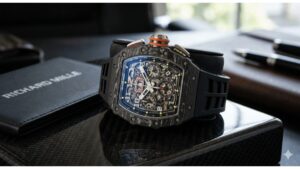
The curve of a tonneau case, the depth of its bezel, and the strap’s exit angle affect how the watch wears. Ask for actual length, width, and thickness, along with side and wrist photographs. A front image alone can conceal substantial differences in profile.
Inspect the relationship between the case, crystal, and visible dial layers. Describe what can be seen without translating it into a claim of identical manufacture. The Richard Mille features article offers a practical visual checklist.
Distinguish Proprietary Materials from Similar Patterns
Richard Mille’s technical descriptions identify proprietary Carbon TPT and Quartz TPT materials in relevant genuine models. A replica’s patterned surface does not establish the same material, process, or structural properties. Ask whether the offered case is a composite, coating, printed finish, or another stated construction.
When evaluating Richard Mille replica watch options, request component-level descriptions rather than a broad carbon label. Weight and appearance can be recorded, but neither alone proves shock resistance, precise alloy identity, or equivalence to the original.
Match the Actual Winding and Functions
The manufacturer identifies the genuine RM 055 as manually wound and the RM 35-02 and RM 67-02 as automatic. It describes the RM 011 with flyback-chronograph functions. A replica using those names must still be checked for its own installed movement and working displays.
Richard Mille super clone watches may show mechanical-style detail that is partly decorative. Ask which visible components are functional and request demonstrations of the relevant controls. A moving balance visible through an opening does not, by itself, establish a tourbillon or the original’s architecture.
Do Not Transfer Sports-Performance Claims
An original model’s documented testing or use in sport belongs to that genuine construction. It should not be applied to a replica on the basis of visual similarity. Keep untested watches away from water and avoid assuming suitability for shocks or demanding activity.
A Hublot replica design provides another bold visual comparison, but sporty appearance is not a performance certificate there either. The Omega water-resistance guide explains the general importance of individual testing rather than copied depth markings.
Compare Functions before Comparing a Reference Name
Write down the expected operation of the specific original reference and then ask what the replica actually provides. Do not treat every RM-style watch as the same mechanical proposition. A chronograph-style layout, a manual-winding description, and an automatic time-only arrangement require different questions.
For the offered replica, request instructions and a demonstration appropriate to the claimed mechanism. A decorated caseback or familiar dial arrangement does not establish the original calibre, winding system, or complete set of functions. Keep any uncertainty visible rather than filling it with information about a genuine model.
Materials deserve the same separation. A patterned case may resemble a proprietary composite without sharing its construction, weight, or tested performance. Assess the replica’s stated material on its own terms.
This creates a balanced comparison of design, operation, and ownership evidence. It does not require either dismissing every visible resemblance or suggesting that a similar appearance confers the original watch’s engineering, manufacturer relationship, or documented performance characteristics.
Compare Support and Replica Value Realistically
Ask who can identify and service the installed mechanism, whether parts are available, and how faults are handled. A factory label does not define the retailer’s obligations. Preserve the specification and written return or repair terms with the order.
Treat replica value as personal enjoyment relative to the complete cost and maintenance uncertainty. Do not assume genuine collectibility or manufacturer warranty coverage. Use the Royal Clone Watches contact page for exact-version questions rather than relying on a general claim of original-level ownership.
Final Thoughts
A responsible comparison makes the differences understandable. Evaluate Richard Mille super clone watches through reference matching, actual dimensions, material descriptions, demonstrated functions, and realistic support. Return to the Richard Mille clone watch selection with separate records for visual appeal and technical evidence. A dramatic design can be appreciated without pretending the replica and original are the same product.



Add comment