
Richard Mille Super Clone Watches: Key Features
Which features deserve attention in Richard Mille super clone watches? The most obvious are the shaped cases, layered dial appearance, and distinctive straps. A useful assessment goes further, asking which details are structural, which are decorative, and which functions can be demonstrated on the exact offered watch.
This feature guide covers tonneau proportions, skeletonised replica dials, carbon-style materials, winding and timing functions, crystal clarity, and strap fit. It separates visual design from unverified claims about high-tech construction or extreme durability.
Begin with the Richard Mille replica watch collection and identify the intended reference. Different RM-style models should not be treated as the same mechanism inside differently coloured cases.
Tonneau Shape, Curvature, and Profile
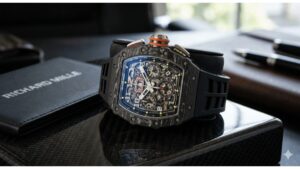
A tonneau-shaped case has a different wrist presence from a conventional round watch. Ask for length, width, thickness, and side photographs that show the curve of the caseback. Review how the strap leaves the case, because a rigid attachment can extend the apparent span across the wrist.
The Richard Mille ultimate guide explains how to compare reference-inspired designs. Actual replica measurements are more useful than dimensions copied from the genuine model’s description.
Visual Depth Without Assumed Mechanical Identity
A skeletonised appearance can combine exposed working parts with decorative components. Inspect the depth between the hands, bridges or covers, and background. Ask which visible elements are part of the actual movement and whether the display view has been altered by a decorative overlay.
Legibility is equally important. Request images with the hands in different positions and under ordinary lighting. A visually complex dial may be attractive yet harder to read at a glance, so decide how much visual activity you enjoy in everyday use.
Material Claims That Need Clarification
Carbon fibre materials, forged composites, coatings, and printed patterns are different descriptions. Ask for the actual construction of each case component. A similar layered pattern does not prove the same proprietary material used by the original manufacturer.
While browsing Richard Mille super clone watch styles, distinguish weight from verified durability. The Richard Mille original-versus-replica article explains why appearance and a lightweight feel cannot establish genuine structural performance.
Reference-Specific Movement Features
Richard Mille identifies the genuine RM 055 as manually wound and the RM 35-02 as automatic. The original RM 67-02 is described as an automatic extra-flat watch, while the RM 011 includes flyback-chronograph functions. These are distinct reference characteristics, not universal specifications for replicas.
Ask the seller which winding type and functions the offered version actually has. Richard Mille super clone watches should come with a clear explanation of crown positions, setting methods, and any controls. A familiar reference number cannot substitute for that information.
Chronograph Details and Working Displays
On an RM-011-style replica, identify the hands and counters used for elapsed time, running seconds, and calendar indications where present. Request a continuous demonstration. An extra subdial or printed scale is not proof that the corresponding function operates.
Do not test flyback behaviour unless the installed mechanism is confirmed to support it and the instructions are clear. A demonstration should show the correct sequence without asking you to infer operation from edited clips. For another chronograph-focused discussion, the Omega movement guide explains the general distinction between display layout and elapsed-time operation.
Check Visual Depth without Assuming Mechanical Complexity
Look at the dial from more than one angle and ask which visible elements belong to the working mechanism. Some details may be decorative plates or bridges rather than parts that perform the function suggested by their appearance. A clear seller explanation should distinguish those elements.
The same approach applies to the case. A patterned surface can be assessed visually, but a photograph alone does not establish the material throughout the component. Ask for a precise description of the construction instead of accepting carbon-style or high-tech as a complete specification.
Bring these observations back to practical use. The crystal should allow you to read the hands, the strap should meet the case securely, and the clasp should hold the watch in a comfortable position. Decorative depth is most satisfying when it does not obscure the basic task of reading the time.
A feature checklist should therefore separate appearance, stated materials, and demonstrated operation. Keeping those categories distinct makes comparison more useful than awarding extra credit for every exposed-looking component or technical word in the listing.
Straps, Fastenings, and Practical Use
Check strap length, flexibility, attachment hardware, and the fit of the buckle or clasp. A shaped case can require a specific fitting, so a generic replacement strap may not work. Ask about spare parts before assuming a later colour change will be straightforward.
Review crystal clarity, the fit of case components, and any documented testing separately. A Hublot replica watch may offer a different bold appearance, but neither a sporty strap nor visible screws establish water resistance or suitability for high-impact activity.
Final Thoughts
A feature is valuable when it improves your understanding of the actual watch. Assess Richard Mille super clone watches through measured proportions, clear material descriptions, readable displays, and demonstrated functions. Return to the Richard Mille clone model selection with reference-specific questions ready. High-tech styling can be enjoyed without treating every visual cue as proof of original engineering.



Add comment